Color anatomy
The exact scoring color for this Flag Tone card.
- HEX
#74ACDF
- RGB
- 116, 172, 223
- HSB
- 209°, 48%, 87%
- HSL
- 209°, 63%, 66%
Nearby tones to compare against
#739CDE#73B9DE#8EB7DE#599EDE#618FBAWhy this color matters
Argentina's flag practically names the colour for you: celeste, sky blue. That makes the outer bands easy to remember as an idea and difficult to match as a value. Memory paints an endless sky or a football shirt, usually pushing the blue brighter and more cyan. The scoring target is quieter: a pale azure whose 48% saturation leaves plenty of white light inside the colour.
A cockade, not a weather report
The documented trail starts with a badge, not a cloud. On 18 February 1812 the government recognised a national cockade in white and sky blue. Nine days later, beside the Paraná River at Rosario, Manuel Belgrano raised a new flag at the Libertad and Independencia batteries using those same colours. The beloved story that blue means the sky and white means clouds is a memorable later reading; Belgrano's own report points directly to the cockade.
Being necessary to raise a flag and not having one, I had it made white and sky blue according to the colours of the national cockade.
Manuel Belgrano, 27 February 1812
Three dates built the flag
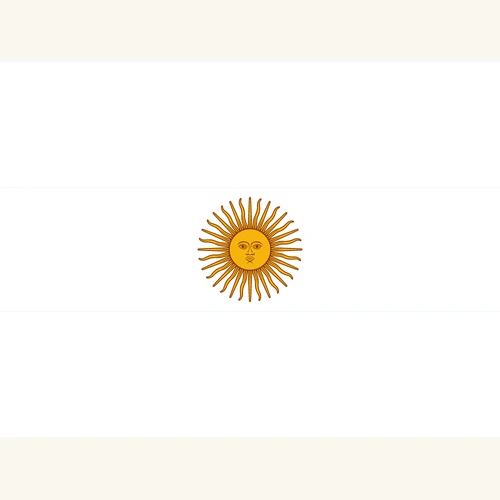
Creation was only the first step. The Congress of Tucumán consecrated “sky blue and white” on 20 July 1816, then ratified the flag in Buenos Aires on 25 February 1818 and added the Inca sun to the centre. Its 32 alternating straight and flaming rays reproduce the sun on Argentina's first coin. Another quiet change came in 1985: Law 23.208 explicitly gave private citizens the same right as governments to use the official flag with the sun.
The exact celeste has a near-twin
The game target is #74ACDF — RGB 116/172/223, HSB(209°, 48%, 87%). Its 209° hue sits 31 degrees toward cyan from pure blue, but the modest saturation keeps it soft rather than tropical; 87% brightness makes it airy without turning pastel-white. Argentina's 2010 decree adopted four IRAM standards for flag colours and construction. The archived National Belgranian Institute table gives the official web reference as #75AADB, RGB 117/170/219, and print references Pantone 284 C / 284 U. That one-step-red, two-step-green, four-step-blue difference is tiny — and real.
Why the sky pulls you off target
Celeste literally invites you to sample whatever sky you remember, yet skies change by weather, screen and photograph; football fabrics add another set of blues. The white centre band makes the outer colour look stronger by contrast, while the golden Sun of May steals attention from the exact band. Match the flat cloth colour: gentler than CSS #87CEEB sky blue and worlds away from France's #000091 navy. The hardest miss is the official #75AADB near-twin, because colour memory cannot reliably hold a difference of only a few RGB steps.
Argentina celeste vs its official near-twin and memory's sky
#74ACDFToon Tone outer-band target#75AADB2010 IRAM web reference — the near-twin#87CEEBCSS sky blue — brighter, more cyan#000091France navy — the opposite blue trapQuick facts
- Target
#74ACDF· RGB 116/172/223 · HSB 209°/48%/87% — the outer bands - Official near-twin
#75AADB· RGB 117/170/219 in the 2010 IRAM web table; print: Pantone 284 C / 284 U - OriginManuel Belgrano · 27 February 1812 · white and celeste copied from the national cockade
- Nota literal sample of sky — that popular reading does not explain the documented cockade
- Reads asindependence · openness · a bright, softened azure