Color anatomy
The exact scoring color for this Flag Tone card.
- HEX
#EE1C25
- RGB
- 238, 28, 37
- HSB
- 357°, 88%, 93%
- HSL
- 357°, 86%, 52%
Nearby tones to compare against
#ED2E1C#ED1C43#ED3942#ED000C#C91821Why this color matters
China's flag is almost all one colour, so this round is a pure test of that red — and it is sneakier than it looks. The true scoring red, #EE1C25, is bright and sits a hair on the cool side of pure red. Yet almost everyone's memory — and most printed and on-screen flags — nudges it the other way, toward a warm, orange lantern-red. The colour you are surest of is the one recall quietly distorts.
A flag designed in an attic
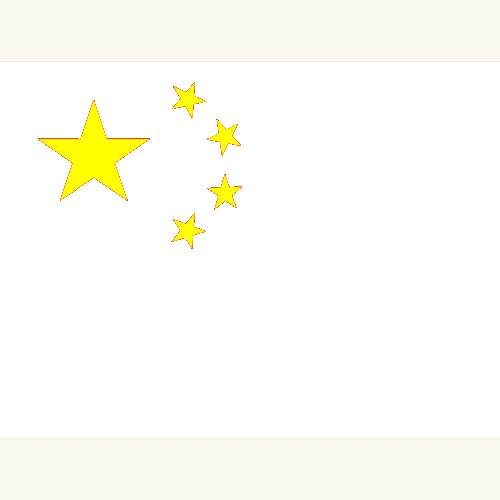
In July 1949 the new government advertised for a national flag. Zeng Liansong, a 32-year-old in Shanghai, sketched his entry over several nights in his attic — one of some 2,992 submissions. His idea: a large golden star for the Communist Party ringed by four smaller ones for the classes of the people, all on a revolutionary red ground. Red was doing triple duty — the revolution, the blood of those who died for it, and the oldest festival-and-fortune colour in Chinese life.
The people are the working class, the peasantry, the urban petty bourgeoisie, and the national bourgeoisie.
Mao Zedong, “On the People’s Democratic Dictatorship,” 1949 — the source of the four stars
Not the red you will reach for
Here is the twist the game exploits. For years the most-copied digital version of the flag used #DE2910, a red sitting at a distinctly warm 7° — orange-leaning. The current reference red, #EE1C25, is the opposite: at 357° it falls just short of pure red on the cool, crimson side. So the instinct to warm the flag toward vermilion is not only a memory slip — it is baked into the flags people have looked at for decades.
A red with no Pantone
The scoring target is #EE1C25 — HSB(357°, 88%, 93%): vivid and bright, high saturation, with that faint cool lean (its blue just edges out its green). Strictly, there is no official swatch to match — the national standard GB 12983-2004 fixes the flag's colour in the CIE 1964 colour space under daylight D65, not as a Pantone chip; the hex we all use is sampled from the reference image. Aim for a clean, luminous red — not orange, and not deep burgundy.
Why the stars are gold
The gold was a colour decision as much as a symbol. On a red ground, yellow reads brighter and cleaner than white would, so the stars seem to glow; officially they are golden rays over a red land. The geometry carries a message too — each small star tips one point toward the big one, so the cluster leans inward as a picture of unity. And the designer never knew he had won until a letter arrived: the committee had shifted his star, dropped an early hammer-and-sickle, and sent a reward of 5,000,000 (old) yuan — about 500 yuan after the currency reform.
China red vs the reds it is not
#EE1C25China flag field (a hair cool)#DE2910the older digital spec — warmer#FF2400scarlet / lantern red — the warm miss#BC002DJapan disc — darker, deeper crimsonQuick facts
- Target
#EE1C25· HSB 357°/88%/93% — bright red, a hair on the cool side - Flagthe Five-star Red Flag; designed by Zeng Liansong, 1949; first raised 1 Oct 1949
- Notwarm lantern-orange (the older
#DE2910drifted warm) — nor burgundy - StandardGB 12983-2004 sets it in CIE colour (D65), not Pantone — no single swatch
- Reads asrevolution · festival red · new China