Color anatomy
The exact scoring color for this Flag Tone card.
- HEX
#00008B
- RGB
- 0, 0, 139
- HSB
- 240°, 100%, 55%
- HSL
- 240°, 100%, 27%
Nearby tones to compare against
#13008C#00138C#11118C#00008C#000069Why this color matters
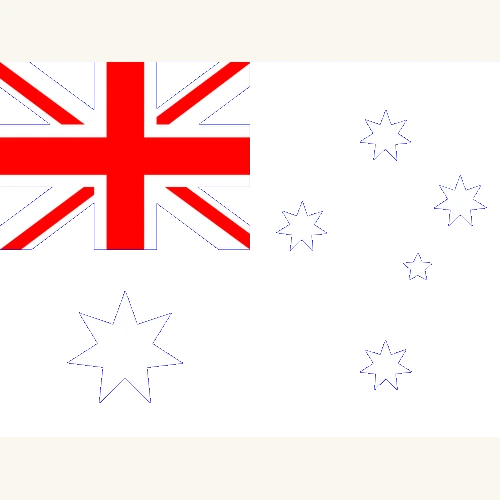
Australia's flag is remembered as stars plus a Union Jack, which makes its largest shape strangely easy to overlook. The main field is the structure holding every white star apart. For this game the target is #00008B: a dark, uncompromised blue that should make the Commonwealth Star and Southern Cross appear almost luminous.
A competition with five winners
After Federation, the 1901 federal competition attracted 32,823 entries. Competitors submitted two coloured sketches: a red ensign for merchant and public use, and a blue ensign for naval and official use. Five nearly identical designs shared the £200 prize, among them a 14-year-old schoolboy, a teenage apprentice, an architect, an artist and a ship's officer. The winning flag first flew over Melbourne's Royal Exhibition Building on 3 September 1901.
The public flag was once the red one
The blue version did not immediately become every Australian's everyday flag. For decades the government discouraged private use of the Blue Ensign, while the Red Ensign became common on land as well as at sea. Robert Menzies opened blue-flag use to private citizens in 1941; the Flags Act 1953, given royal assent on 14 February 1954, finally declared the blue design the Australian National Flag.
The Australian National Flag is a blue flag.
Flags Act 1953, Schedule 1
The law defines a design, not a Hex code
Schedule 1 specifies the Union Jack, the exact positions and diameters of the stars, and even their number of points, but it does not prescribe RGB, HSB or Hex. #00008B is this game's exact digital target, not a statutory dye formula. It is HSB(240°, 100%, 55%): pure blue in hue, fully saturated, with both red and green channels at zero. Memory often lifts the brightness after averaging the field with its white stars; the target must remain genuinely dark.
The seventh point came later
The 1901 Commonwealth Star had six points for the six federating colonies. A seventh was added in 1908 for the territories and any future states. The Southern Cross follows a different count: four large stars have seven points, while the smaller Epsilon Crucis has five. The flag's white geometry therefore carries the constitutional story, while the dark field turns that geometry into a southern-sky image.
Australia's field vs the navies memory confuses
#00008BAustralia field — the game target#000091France hoist — only six blue-channel steps lighter#00247DNew Zealand field — greener and darker#012169United Kingdom field — greener, greyer and darkerQuick facts
- Target
#00008B· RGB 0/0/139 · HSB 240°/100%/55% - In lawthe Flags Act 1953 says “blue flag”; it does not mandate a Hex value
- Origin32,823 competition entries · five joint winners · first flown 3 September 1901
- Revisionthe Commonwealth Star gained its seventh point in 1908
- Reads assouthern sky · federation · maritime Blue Ensign heritage