Color anatomy
The exact scoring color for this Flag Tone card.
- HEX
#0039A6
- RGB
- 0, 57, 166
- HSB
- 219°, 100%, 65%
- HSL
- 219°, 100%, 33%
Nearby tones to compare against
#0024A6#0050A6#1447A6#003AA6#002E82Why this color matters
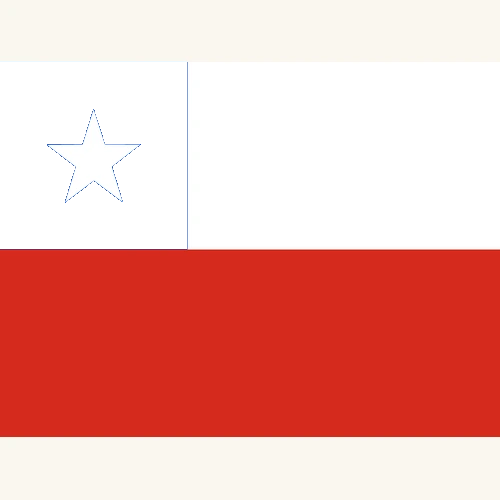
Chile's blue is a geometry problem before it is a symbolism quiz. The target is only the square canton around the white star — not a full-height panel and not the whole upper band. On a 2:3 flag, that blue runs one third of the fly by half the hoist, so its two dimensions are equal. Remember the square and you have already avoided the most common Texas-shaped mistake.
Adopted in 1817, unveiled in 1818
Chile's 1967 emblem decree looks back to the original Ministry of War decree of 18 October 1817, when the current flag was instituted under Supreme Director Bernardo O'Higgins and José Ignacio Zenteno served as War Secretary. The flag's ceremonial public debut came later, during the oath of independence on 12 February 1818. Those are two different milestones: legal creation first, national presentation second.
The upper band is turquí blue in the third immediately next to the hoist and white in the remaining two thirds.
Chile, Supreme Decree No. 1,534 (1967)
A square hidden inside a 2:3 rectangle
Supreme Decree No. 1,534 makes the construction almost a proof. The red and upper bands have equal height; the upper band is one-third blue and two-thirds white along the fly. Because the whole flag is 2 units high by 3 wide, the canton is 1 by 1 — a square. The law also fixes the star's circumscribed diameter at half one side of that square. The lone star is not placed by eye.
The law says turquí, not a hex
Here is the colour fact most reproductions hide: Chilean law names azul turquí, white and red, but prescribes no Pantone, RGB or six-digit hex. #0039A6 is therefore this study's consistent digital target, not a legal formula. It converts to RGB 0/57/166 and HSB(219°, 100%, 65%): completely saturated, medium-dark blue, shifted about 21° toward cyan from pure 240° blue because green is present while red is zero.
One star, two Lone Stars
Chile calls the flag La Estrella Solitaria. Its resemblance to Texas is strong enough that in 2017 the Texas House adopted H.C.R. 75, urging Texans not to use the Chile flag emoji for the Lone Star Flag. Chile's design was adopted in 1817; Texas adopted its present flag in 1839. Their geometry and specifications separate them: Texas gives Pantone 281 a full-height panel, while Chile confines azul turquí to a square and gives it no numeric colour formula. Sky and Pacific for the blue, and guidance for the star, are common readings; the decree itself defines colour names and construction, not those meanings. In the game, the same resemblance that fooled emoji users pulls memory toward Texas, while familiarity with Ukraine pulls it the other way.
Chile canton blue vs the blues memory borrows
#0039A6Chile canton — the target#00205BTexas Pantone 281 conversion — much darker navy#0057B8Ukraine top band — brighter and more cyan#74ACDFArgentina outer band — pale sky blueQuick facts
- Target
#0039A6· RGB 0/57/166 · HSB 219°/100%/65% — the blue canton - Legal wordingazul turquí; Chilean law specifies no Pantone, RGB or hex value
- NotTexas navy — Chile's blue is lighter, and its canton is square rather than full-height
- Timelineinstituted 18 October 1817 · presented at the independence oath on 12 February 1818
- Reads asclear · saturated · medium-dark · a lone star precisely centred in a 1-by-1 canton