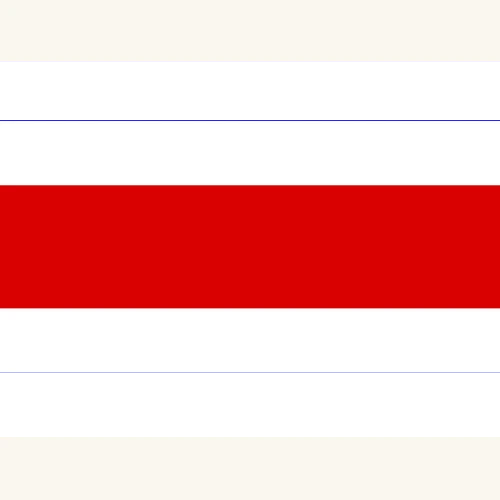
Color anatomy
The exact scoring color for this Flag Tone card.
- HEX
#0000B4
- RGB
- 0, 0, 180
- HSB
- 240°, 100%, 71%
- HSL
- 240°, 100%, 35%
Nearby tones to compare against
#1800B5#0018B5#1616B5#0000B5#000091Why this color matters
Costa Rica's flag makes the eye travel to the red centre or the coat of arms. The colour to match here lives on both outsides: two blue bands, each narrower than the red centre but visually strong. The scoring target is #0000B4, a pure, fully saturated blue of medium-high brightness. It is not France's darker navy, and it is not a generic sky blue.
A Central American flag with a French memory
The Costa Rican design is widely credited to Pacífica Fernández Oreamuno, who created it in 1848 during the presidency of José María Castro Madriz. Its blue, white and red order was inspired by the French tricolore and the ideals of liberty, equality and fraternity. The current horizontal pattern was confirmed in later regulations; the outer blue bands remained the frame around the red heart.
The blue and white are half the size of the red.
Costa Rica flag law description, quoted by Flags of the World
Two blues, one flag function
The national flag and the state flag are not identical in use. The state version carries the coat of arms in the red stripe, while the simpler flag omits it for ordinary civil display. Neither version changes the outer bands' job: they hold the centre in a blue-white-red-blue-white rhythm. A crest in the middle can steal attention, so memory often files the blue as a darker, more official navy than this target.
The exact outer blue
The target is RGB 0/0/180 — HSB(240°, 100%, 71%), rounded to whole numbers. Red and green are both zero, so the hue is pure blue at 240°: there is no cyan or magenta lean. Full saturation and 71% brightness make it vivid without becoming whitewashed. That is why a guess of France's #000091 looks too dark, while Chile's #0039A6 shifts the blue toward cyan.
Sky, ideals and a practical trap
Common explanations associate Costa Rica's blue with the sky, opportunities, ideals and perseverance, white with peace and wisdom, and red with warmth and blood shed for freedom. These are later symbolic readings, not a hexadecimal recipe. The practical memory hook is geometric: two blue outer bands, each half the width of the red centre. Keep that 1:1:2:1:1 rhythm in mind, then resist borrowing the navy from France or the brighter cyan pull from Chile.
Costa Rica blue beside the blues memory might substitute
#0000B4Costa Rica outer bands — target#000091France navy — darker, same pure-blue hue#0039A6Chile canton — less bright, slightly cyanward#0057B8Ukraine top band — brighter and more cyanQuick facts
- Target
#0000B4· RGB 0/0/180 · HSB 240°/100%/71% — the outer blue bands - OriginDesign credited to Pacífica Fernández Oreamuno in 1848; French tricolore ideals echoed
- Not interchangeableFrance's navy is darker; Chile and Ukraine pull the hue brighter and toward cyan
- Flag rhythmFive horizontal bands in a
1:1:2:1:1width pattern, with red at the centre - Reads assky and ideals · civil simplicity · a vivid blue frame around the tricolore