Color anatomy
The exact scoring color for this Flag Tone card.
- HEX
#FFCC00
- RGB
- 255, 204, 0
- HSB
- 48°, 100%, 100%
- HSL
- 48°, 100%, 50%
Nearby tones to compare against
#FFEE00#FFAA00#FFD21F#FFCC00#DBAF00Why this color matters
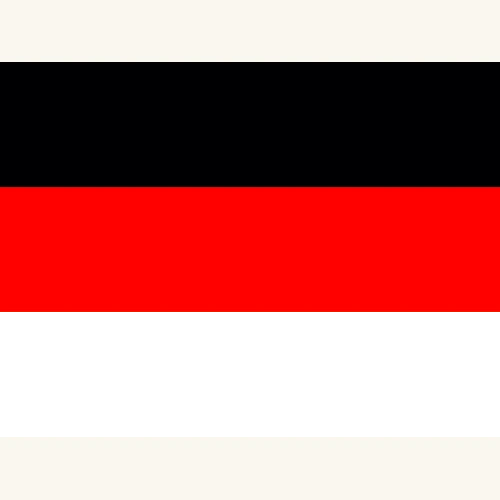
Germany's bottom band sets a two-way trap. Call it yellow and memory slides towards lemon; take the constitutional word gold too literally and it sinks towards mustard or metal. The target does neither. #FFCC00 is a warm, screen-bright gold-yellow: maximum saturation, maximum brightness and a hue already twelve degrees towards orange from pure yellow.
Before the tricolour, a student banner
The familiar origin story points to the Lützow Volunteer Corps: black uniforms, red piping and gold-coloured brass buttons. The Bundestag cautions that the colours' origin cannot be proved conclusively. Firmer evidence survives in the Jena student fraternity's 1816 banner, carried at the Wartburg Festival on 18 October 1817. It was not today's flag, but three red-black-red bands crowned with golden oak leaves. The Bundestag adds another myth-bust: the colours gained national meaning partly because people mistakenly believed they belonged to the old German Empire.
The federal flag shall be black, red and gold.
Basic Law, Article 22(2)
From protest colours to state colours
Black-red-gold filled the Hambach Festival in 1832, where one surviving flag proclaimed Deutschlands Wiedergeburt — “Germany's rebirth”. In 1848, the Frankfurt Federal Diet and National Assembly made the combination the colours of the German Confederation and the projected German Reich. After the black-white-red imperial era, it returned with the Weimar Republic in 1919. The Parliamentary Council restored it in 1949 with only one vote against; on 3 October 1990, it became the flag of reunified Germany.
Gold is a legal word, not a metal effect
Article 22 says gold. The 1996 Flag Order calls the bottom stripe gold-coloured, requires three equal bands and a 3:5 ratio, but supplies no RGB value. Germany's Federal Agency for Civic Education explains that heraldic gold is represented by yellow in practice, just as silver is represented by white. The federal government's Corporate Design maps its national-colour Gold to #FFCC00, RGB 255/204/0. That is an official digital swatch for federal communications, not a statutory dye formula for every fabric flag.
A yellow already at full power
#FFCC00 is HSB(48°, 100%, 100%). Pure yellow sits at 60°, so Germany's gold is twelve degrees warmer, towards orange; its blue channel is zero and its green channel sits 51 points below red. Both saturation and brightness are already at maximum. The word gold tempts players to darken or mute it, while generic “flag yellow” pushes the hue back towards lemon. The target is flat, luminous warm yellow — not a metallic effect, mustard or amber.
Germany's gold against the yellows around it
#FFCC00Germany bottom band — warm gold-yellow#FECB00Sweden cross — a near twin#FFE800Colombia top band — cooler and yellower#FF9933India saffron — more orange and less saturatedQuick facts
- Target
#FFCC00· RGB 255/204/0 · HSB 48°/100%/100% — 12° warmer than pure yellow - Official wordingThe Basic Law says gold; federal Corporate Design maps Gold to
#FFCC00 - First political formThe 1816 red-black-red Jena banner with golden oak leaves was carried at Wartburg on 18 October 1817
- State colourOfficial in 1848 · restored in 1919 and 1949 · flag of reunified Germany since 3 October 1990
- Reads asunity · freedom · democratic tradition · fully luminous warm gold-yellow