Color anatomy
The exact scoring color for this Flag Tone card.
- HEX
#CE1126
- RGB
- 206, 17, 38
- HSB
- 353°, 92%, 81%
- HSL
- 353°, 85%, 44%
Nearby tones to compare against
#CF1411#CF1140#CF293D#CF0018#AB0E20Why this color matters
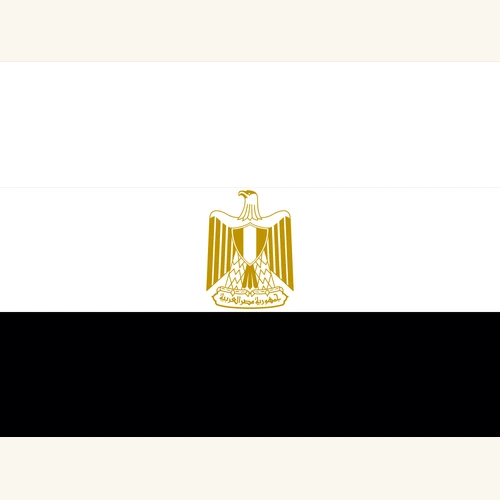
Egypt's top band carries a double camouflage. First, red-white-black is a shared grammar across several modern Arab flags; without the golden eagle, the bands can look generic. Second, the law calls the colour red without telling a screen which red. Toon Tone fixes that ambiguity to #CE1126, a cool crimson whose small blue bias is exactly what colour memory tends to erase.
From royal green to a revolutionary tricolour
The Kingdom of Egypt flew a green flag from 1923. At the six-month celebration of the 23 July 1952 Revolution, a new revolutionary flag appeared with red, white and black bands and an eagle at its centre. The palette marked a break from the monarchy and placed Egypt within the wider Arab Liberation colour family; the current presidency describes its red as power, hope and the blood of martyrs.
The national flag of the Arab Republic of Egypt consists of three colors; black, white, and red with an eagle taken from the “Eagle of Salah El Din” in golden yellow.
Constitution of the Arab Republic of Egypt, Article 223
The bands stayed; the emblem kept changing
The 1958 union with Syria replaced the eagle with two green stars, one for each country. The Federation of Arab Republics put the Hawk of Quraish in the white band in 1972. Egypt installed the Eagle of Saladin in October 1984. The current flag's date therefore belongs to its emblem, not to the birth of the red-white-black tricolour, which is an inheritance of the 1952 Revolution.
Red is legal; the hex is not
Article 223 names the four colours but assigns no Pantone, RGB or hexadecimal values. The London 2012 production manual approved through Egypt's national Olympic committee used Pantone 186; the 2023 Album des Pavillons records that reference as RGB 200/16/46, or #C8102E. Toon Tone scores #CE1126. These are neighbouring production references, not proof that one piece of Egyptian cloth invalidates another.
The exact cool red
#CE1126 is RGB 206/17/38, HSB(353°, 92%, 81%). Its hue sits seven degrees on the magenta side of pure red; because blue 38 exceeds green 17, it leans cool rather than orange. Saturation is very high, but brightness stops at 81%. The hard boundary against the white band encourages memory to substitute a generic primary red, so retain the blue-over-green relationship. An older State Information Service account tied red specifically to the pre-1952 struggle against British occupation: symbolic readings evolve, but the channel mathematics do not.
Egypt red vs the production near-twin and reds memory borrows
#CE1126Toon Tone Egypt top-band target#C8102EPantone 186 production near-twin — slightly darker, more magenta#D52B1ECanada side bands — warmer, more orange#EE1C25China field — brighter, nearer pure redQuick facts
- Target
#CE1126· RGB 206/17/38 · HSB 353°/92%/81% — the top band - Legal wordingArticle 223 names red but sets no Pantone, RGB or hex value
- Notthe
#C8102EPantone 186 production reference — a near-twin, not the scoring value - Timeline1952 tricolour · 1958 stars · 1972 hawk · October 1984 Eagle of Saladin
- Reads asrevolution · power · hope · sacrifice · Arab liberation