Color anatomy
The exact scoring color for this Flag Tone card.
- HEX
#012169
- RGB
- 1, 33, 105
- HSB
- 222°, 99%, 41%
- HSL
- 222°, 98%, 21%
Nearby tones to compare against
#011269#012E69#0E2969#001F69#011545Why this color matters
The most-copied flag on earth rests on a blue that its own official wording calls Azure — heraldry's bright blue. The cloth is a deep navy. Both statements are true, and the gap between them is exactly why this card is easy to get wrong.
Blue arrived with Scotland
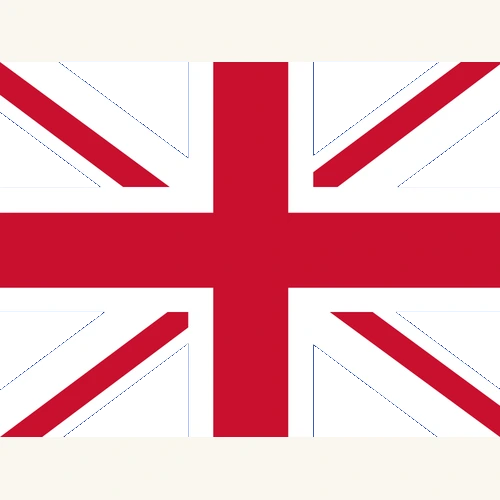
The 1606 flag of Great Britain laid the white saltire of St Andrew, a white cross on a blue field, over England's red cross of St George. When the Act of Union 1800 joined Great Britain and Ireland, an order in council created the design still flown today: the red saltire of St Patrick threaded between the other two. It has not changed since, not even when the Irish Free State left in 1922 — and no law ever made it the national flag. It became one through precedent.
And that the Union Flag shall be Azure, the Crosses Saltires of St. Andrew and St. Patrick Quarterly per Saltire, counterchanged Argent and Gules…
Proclamation of 1 January 1801
Azure on paper, navy in cloth
Azure in heraldry is a bright blue, and the flag's blazon has said so for two centuries. The approved flag is nothing of the kind. Its blue is a deep navy, fixed today as Pantone 280C and approved as #012169 by the Garter King of Arms under the Earl Marshal. The reason is maritime: the shade descends from the Royal Navy's historic Blue Squadron ensign, and dark dyes were chosen at sea because they lasted longer in sun and salt spray. A colour that began life as a heraldic word ended up as practical cloth.
The exact blue
The scoring blue is #012169 — HSB(222°, 99%, 41%). Two of those numbers do the work. The first is 41%: the field sits at less than half brightness, so the white fimbriation around each cross should almost glare against it. The second is 222°, which is not the 240° of pure blue — it leans 18° towards cyan, and that slight coolness is what makes the field read as navy rather than royal. Saturation is 99%, so there is no grey in this blue; there is only darkness.
The blue that travelled, and the corner that gives it away
Because the flag was a naval ensign before it was a national one, its blue travelled the world on the ensign system: Australia, New Zealand and a run of former territories still fly fields of the same depth. Its closest neighbour in colour is not a rival navy but the European flag's blue — a different Pantone, Reflex Blue, at almost the identical hue of 220° and far brighter. The same blue, 19 points apart in brightness. Two more details reward the careful eye. Wales is absent, because the 1606 design was drawn while Wales was already part of the Kingdom of England. And the flag has a right way up: at the hoist the broader white diagonal sits above the red one, which the flag world summarises as “wide white top”. The name is the last trap — in 1902 the Admiralty ruled that either name, Union Flag or Union Jack, could be used officially.
The navy trap: the flag blue beside the blues memory substitutes
#012169Union Flag blue — target, Pantone 280C#003399EU flag blue — near-identical hue, far brighter#0055A4France's 1976–2020 lighter blue#4169E1CSS royalblue — the bright missQuick facts
- Target
#012169· HSB 222°/99%/41% — the field, Pantone 280C - ApprovedGarter King of Arms under the Earl Marshal; MoD 8711D; formerly BCC ‘Union Jack Blue’ 218
- OriginScotland's blue saltire field; 1606 decree, 1707 national flag, 1801 current design
- Notroyalblue, or the EU's brighter Reflex Blue — this field is under half brightness
- Reads asnavy depth · the ensign blue that circled the world