Color anatomy
The exact scoring color for this Flag Tone card.
- HEX
#006B3F
- RGB
- 0, 107, 63
- HSB
- 155°, 100%, 42%
- HSL
- 155°, 100%, 21%
Nearby tones to compare against
#006B4D#006B30#0D6B44#006B3E#00472AWhy this color matters
Think of Ghana's flag and the black star is likely to arrive first. But the part to match is the green beneath the gold band: a deep, fully saturated green with a blue lean. The star supplies the landmark; it does not supply the shade. This card's #006B3F rewards remembering a dark field of vegetation, rather than reaching for a generic bright leaf green.
An artist reads the landscape
Theodosia Okoh designed the flag adopted at Ghana's independence on 6 March 1957. Its red, gold and green belong to the Pan-African colour family, but Okoh also explained them through Ghana's geography. Ghana's Permanent Mission to the United Nations identifies green with the country's rich forests and natural wealth; gold with mineral wealth; and red with those who died in the independence struggle. Her palette joined a continental statement to a particular landscape.
I decided on the three colors of red, gold & green because of the geography of Ghana.
Theodosia Salome Okoh, quoted by GhanaWeb
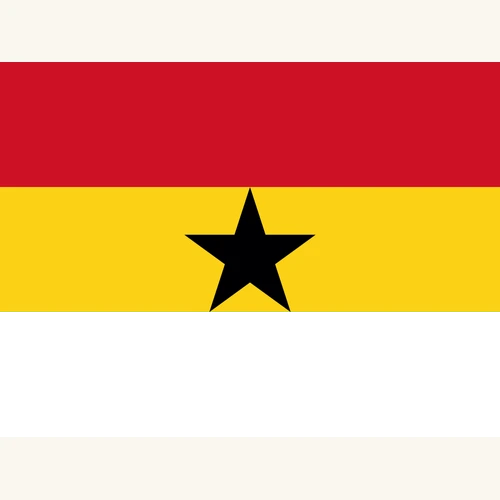
The middle stripe once turned white
The familiar tricolour was not continuous. From 1964 to 1966, white replaced the central gold stripe, reflecting the colours of the ruling Convention People's Party. Green remained the bottom band. The red-gold-green design returned after Kwame Nkrumah's overthrow in 1966. A historical photograph with a white centre therefore need not be a faded or badly coloured version of the current flag: it may show a different design.
The exact forest green
The target is RGB 0/107/63 — HSB(155°, 100%, 42%), rounded to whole numbers. Green is strongest, blue is substantial and red is absent. The hue lies about 35° from pure green at 120° towards cyan at 180°, giving it a cool, blueward lean. Full saturation does not mean high brightness: the 42% HSB brightness is what keeps this green deep. #006B3F is this card's digital reference; the mission's description establishes the symbolism, not a hexadecimal specification.
The Black Stars can steal the green
Ghana's national football team takes its Black Stars nickname from the flag's central emblem, a symbol of African emancipation. That link makes the star easy to recall while the forest green can blur into a general idea of national colours. The mistake is to turn the meaning of vegetation into a sunlit lime or grassy yellow-green. Nigeria's outer-band card is a close neighbour in hue; Portugal's green and Brazil's field provide other familiar alternatives. The comparison below keeps Ghana's particular mix of depth and blue in view.
Ghana green beside three neighbouring flag greens
#006B3FGhana bottom band — target#008753Nigeria outer bands — similar hue, higher HSB brightness#006600Portugal hoist — pure-green hue, no blue channel#229E45Brazil field — brighter, towards yellowQuick facts
- Target
#006B3F· RGB 0/107/63 · HSB 155°/100%/42% — the green bottom band - Designer & originTheodosia Okoh · adopted at independence on 6 March 1957
- Not a generic leaf greenThe target needs a blue lean and low HSB brightness, even at full saturation
- Colour detour1964–1966: white replaced the middle gold stripe; green stayed at the bottom
- Reads asrich forests · natural wealth · African emancipation beside the Black Star