Color anatomy
The exact scoring color for this Flag Tone card.
- HEX
#CD2E3A
- RGB
- 205, 46, 58
- HSB
- 355°, 78%, 80%
- HSL
- 355°, 63%, 49%
Nearby tones to compare against
#CC352D#CC2D4F#CC4551#CC1424#A82530Why this color matters
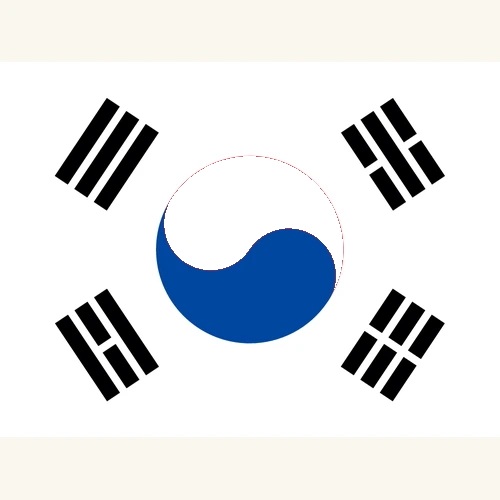
The neat red-blue opposition of South Korea's flag invites categorical memory: pure red against pure blue. That mental shorthand quietly erases the real taegeuk red's lower saturation and brightness, replacing it with something closer to screen red. The actual upper swirl is more restrained — a slightly cool, print-like crimson rather than #FF0000.
A flag required by diplomacy
Korea had no national flag when foreign treaties made one necessary in the late Joseon period. A four-trigram taegeuk design made by Lee Eung-jun was already used at the Korea–United States Treaty on 22 May 1882. Later that year, diplomat Park Yeong-hyo recorded making three flags during his voyage to Japan, using one from 25 September and reporting the design to the government on 3 October. King Gojong promulgated the Taegeukgi as the national flag on 6 March 1883.
The taegeuk ... denotes the harmony between the negative cosmic forces (yin: blue portion) and the positive cosmic forces (yang: red portion).
Ministry of the Interior and Safety
A story too neat
The voyage account is memorable, but it has often hardened into the claim that Park invented the flag from scratch at sea. The May treaty flag predates his September voyage. The safer history is collaborative and evolving: Lee left the earlier documented design, Park left the clearest account of making and using it abroad, and the government later standardised a flag that had circulated in many variants. Modern construction rules were announced on 15 October 1949.
A legal red, not generic red
Current regulations do not merely say “red”. They define the taegeuk red as Munsell 6.0R 4.5/14 and CIE (x, y, Y) = (0.5640, 0.3194, 15.3). Toon Tone renders that standard as #CD2E3A — HSB(355°, 78%, 80%). With blue at 58 and green at 46, it leans about five degrees towards magenta from pure red: slightly cool, not orange. Its 78% saturation and 80% brightness make it deliberately quieter than a screen primary.
Not a battle between opposites
The two halves are not good versus evil, nor a red South set against a blue North. The red yang and blue yin are complementary forces whose interaction creates and changes all things. The four black trigrams extend that motion through heaven, earth, water and fire, while the white field represents brightness, purity and peace. Memory compresses that whole system into two simple colour labels — “red” and “blue” — then pushes both towards maximum screen saturation. The winning move is to preserve the measured crimson instead of completing the symbol from memory.
South Korea's taegeuk red against the reds it is not
#CD2E3ASouth Korea taegeuk — restrained and slightly cool#E70011Indonesia top band — brighter and fully saturated#BC002DJapan disc — darker and more magenta-leaning#FF0000Screen red — memory's oversimplificationQuick facts
- Target
#CD2E3A· HSB 355°/78%/80% — restrained crimson with a slight cool lean - Legal colour
Munsell 6.0R 4.5/14·CIE (x, y, Y) = (0.5640, 0.3194, 15.3) - First documented useA four-trigram design appeared at the Korea–United States Treaty on 22 May 1882
- StandardisedConstruction rules announced on 15 October 1949 after years of variant designs
- Reads aspositive yang · motion · harmony · restrained printed crimson