Color anatomy
The exact scoring color for this Flag Tone card.
- HEX
#FECB00
- RGB
- 254, 203, 0
- HSB
- 48°, 100%, 100%
- HSL
- 48°, 100%, 50%
Nearby tones to compare against
#FFEE00#FFAA00#FFD21F#FFCC00#DBAF00Why this color matters
Sweden's yellow cross is often remembered as a generic bright yellow, but the exact target has two different kinds of authority. #FECB00 is the Swedish Institute's digital Sweden Yellow Standard. The flag law itself never names a hex: it calls the cross guldgul, or golden yellow, and anchors the colour through physical standards. This card sits where law, cloth and screen translation meet.
A Danish shape in Swedish colours
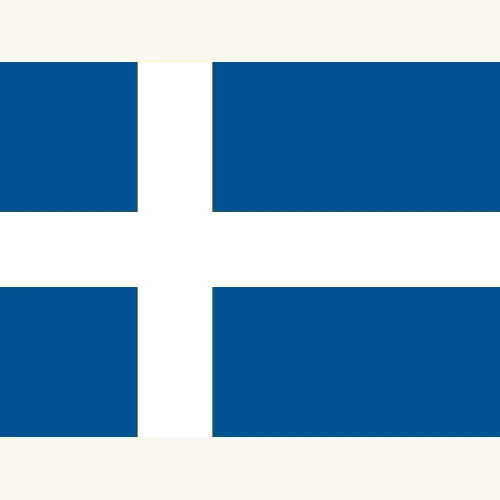
Riksarkivet traces the flag to the mid-16th century. Its Nordic cross is believed to have been modelled on Denmark's Dannebrog, while the palette came from Sweden's arms: three golden crowns in a blue field and a gold cross quartering the greater coat of arms. The origin is not the modern postcard story of blue sky and yellow wheat. Those are later associations; official history points to heraldry. National Flag Day has been observed nationwide on 6 June since 1916, and the date became Sweden's National Day in 1983.
It has proved impossible to reproduce the colours accurately in print.
Swedish Government Bill No. 115, 1906 (translation)
When cloth samples stopped being enough
The 1906 standard shifted away from the near-black blue and deep orange-yellow then in use, calling for a lighter blue and a golden yellow with an orange pull. Because ink and light passing through cloth did not match, fabric samples became the practical reference. By the 1982 rewrite, some 1908 samples were missing and the survivors had visibly faded or discoloured. The current Act (1982:269) fixes the geometry and names the cross guldgul; its 5+2+9 by 4+2+4 grid makes yellow exactly 30% of the 10:16 rectangular flag.
Where #FECB00 becomes official
Ordinance 1983:826 defines yellow as NCS 0580-Y10R and CIE x=0.472, y=0.465, Y=64.4, with tolerances. It does not prescribe a hex. Sharing Sweden's national identity system performs the digital translation: Sweden Yellow Standard is #FECB00, RGB 254/203/0, with Pantone 116 C for coated stock and 109 U for uncoated stock alongside the same NCS designation. The target is therefore an official national-brand screen value, not a hex hidden in the flag act.
The exact warm yellow
The target #FECB00 is RGB 254/203/0, HSB 48°/100%/100%. Pure yellow sits at 60°, so 48° moves 12° toward red and orange: warm golden yellow, not lemon. Blue is zero, saturation is maximal and brightness rounds to 100%. The trap is how little separates it from category memory: #FFCC00 adds only one red and one green. Against Sweden's blue field the cross feels unmistakable; alone, players often cool it toward Ferrari yellow.
Sweden yellow against the near-twins memory merges
#FECB00Sweden Yellow Standard#FFCC00Germany bottom band#FBCE07Shell yellow#FCE500Ferrari scudetto yellowQuick facts
- Target
#FECB00· RGB 254/203/0 · HSB 48°/100%/100% · Sweden Yellow Standard - Originmid-16th-century Nordic cross · yellow and blue drawn from Sweden's arms
- Nota statutory hex; the Act says guldgul, while Ordinance 1983:826 specifies NCS/CIE
- Geometry10:16 flag · cross width 2 units · exactly 30% of the rectangular area
- Reads aswarm gold · Nordic clarity · state continuity