Color anatomy
The exact scoring color for this Flag Tone card.
- HEX
#E30A17
- RGB
- 227, 10, 23
- HSB
- 356°, 96%, 89%
- HSL
- 356°, 92%, 46%
Nearby tones to compare against
#E31809#E30935#E32431#E3000F#BF0814Why this color matters
Turkey's flag is so familiar that memory compresses it into a recipe: red field, white crescent, white star. That shortcut hides the card's real difficulty. The field is not default screen red, and even its Turkish names carry more weight than the generic label: al bayrak, the red or scarlet flag, and al sancak, the red banner. Here colour is not decoration around the emblem; it is half the flag's name.
An Ottoman flag the Republic kept
The crescent and star developed on Ottoman flags in the late 18th and early 19th centuries, with the white five-pointed-star form on red established around 1844. When the Republic was proclaimed in 1923, it retained that final Ottoman design. Law No. 2994 of 29 May 1936 standardised the construction; today's Law No. 2893, adopted on 22 September 1983, repealed the earlier act but kept the same essential definition and geometry.
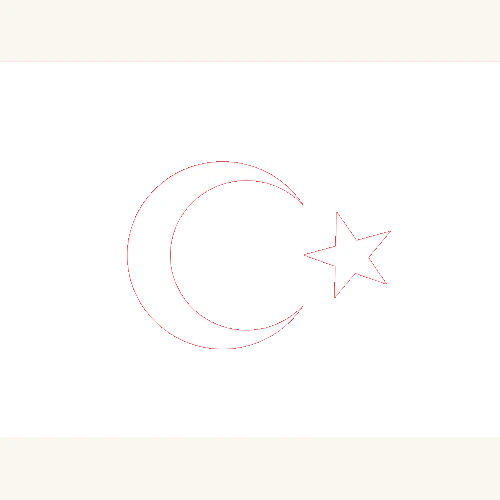
The Turkish flag is composed of a white crescent and star on a red background.
Constitution of the Republic of Türkiye, Article 3
The pool of blood is folklore
The most-repeated origin story sees a crescent and star reflected in a pool of soldiers' blood after battle. Its dates, battlefields and sultans change with the teller; no contemporary design record establishes it as the flag's documented birth. Treat it as national folklore, not a colour specification. The historical trail is plainer: Ottoman naval and state symbols evolved over decades, and the five-pointed star settled into place in the 19th century.
A law written for cloth, not screens
Türkiye's implementing regulation is unusually physical about colour. It does not publish a CSS hex: it specifies the scarlet field with coordinates of 27.5 for lightness, 44.8 on the red-green axis and 15.6 on the yellow-blue axis, allowing at most 3 NBS units of difference. It even defines the white emblem through reflectance at 460 and 620 nanometres and requires flag producers to hold T.S.E. certification. The legal object is dyed fabric under measured light; #E30A17 is Toon Tone's consistent digital target for this study.
The exact red
That target is RGB 227/10/23 and HSB(356°, 96%, 89%). At 356°, it sits about four degrees to the cool, magenta side of pure red; the blue channel at 23 is greater than green at 10, so this is not an orange-leaning scarlet. Brightness stops at 89%, preserving a dense field behind the white crescent and star. The player mistake is to let the simple word “red” push every slider to #FF0000. Keep the slight blue bias and the lower brightness instead.
Turkey red vs the flag reds memory substitutes
#E30A17Turkey field — the target#FF0000pure screen red — the reflex guess#DA251DVietnam field — warmer and more orange#DC143CPoland lower band — more crimsonQuick facts
- Target
#E30A17· RGB 227/10/23 · HSB 356°/96%/89% — a dense, slightly cool red - Nameal bayrak, the red or scarlet flag; al sancak, the red banner
- Not
#FF0000— and not Vietnam's warmer#DA251D - Standardised29 May 1936 under Law No. 2994 · current Law No. 2893 adopted 22 September 1983
- Reads asceremony · high contrast · Ottoman-to-Republic continuity · national identity