
Color anatomy
The exact scoring color for this Flag Tone card.
- HEX
#0057B8
- RGB
- 0, 87, 184
- HSB
- 212°, 100%, 72%
- HSL
- 212°, 100%, 36%
Nearby tones to compare against
#003DB8#006EB8#1661B8#0056B8#004594Why this color matters
Ukraine's flag looks like two easy rectangles; the hard part is remembering which blue and which way up. The legal answer is blue on top, yellow below, yet memory often says “yellow-blue” because older banners used both orders, language names the pair inconsistently, and photographs flatten the difference between azure and navy. This card targets only the top band: #0057B8.
A first sighting, not a single birth
The modern colour pairing reaches back to the Spring of Nations. On 25 June 1848, two blue-and-yellow cloths appeared anonymously on Lviv's (then Lemberg's) City Hall; the Supreme Ruthenian Council had already discussed blue and yellow as Ruthenian colours in May. Their heraldic neighbour was the golden lion on a blue field of Galicia–Volhynia. Early displays varied in shade and sometimes in order, so there is no clean, one-day birth certificate for the flag.
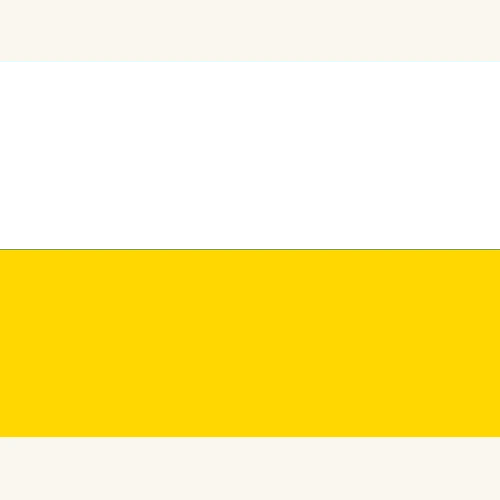
The upper one is blue, the lower one is yellow.
Verkhovna Rada Resolution 2067-XII (28 January 1992)
The order was debated before it was settled
Both blue-over-yellow and yellow-over-blue appeared during the upheavals of 1917. The legal acts of 1918–1921, however, repeatedly describe blue or azure above yellow; modern law is unambiguous. The popular picture of blue sky over golden wheat is a later visual reading, not wording in the Constitution or the 1992 resolution. Black-and-white photographs and the everyday phrase “yellow-blue” make a convincing memory trap, but neither proves that the flag should be flipped.
A flag returned in stages
The blue-and-yellow banner returned to public life before independence: Stryi raised it on 14 March 1990, Kyiv City Hall followed on 24 July 1990, and MPs carried one into the Verkhovna Rada on 23 August 1991. It was ceremonially raised over parliament on 4 September 1991; independence had been declared on 24 August. Resolution 2067-XII formally approved the national flag on 28 January 1992, and a presidential decree later made 23 August the annual Day of the State Flag in 2004.
The exact blue is not a simple hex
The game target is #0057B8 — RGB 0/87/184 and HSB(212°, 100%, 72%). A hue around 211.6° is a saturated blue shifted roughly 28° toward cyan from pure 240° blue: cool and slightly cyanward, not violet or near-black. Ukraine's DSTU 4512:2006 standard describes the flag with chromaticity coordinates and lists PANTONE 2935 C for print rather than mandating one six-digit hex; #0057B8 is Toon Tone's consistent digital swatch. The player mistake is to confuse 100% saturation with high brightness, then choose a brighter sky blue or a dark navy.
Ukraine blue vs the blues memory substitutes
#0057B8Ukraine top band — the target#0057B7one-step digital variant — a Pantone conversion neighbour#87CEEBsky blue — the bright memory shortcut#000080navy — the too-dark driftQuick facts
- Target
#0057B8· RGB 0/87/184 · HSB 212°/100%/72% — the top-band blue - Legal orderequal horizontal bands, blue above yellow, in a 2:3 flag under Resolution 2067-XII of 28 January 1992
- Nota single legally mandated hex — DSTU 4512:2006 uses chromaticity coordinates and PANTONE 2935 C for print
- Returnpublic revival from Stryi on 14 March 1990 to formal approval on 28 January 1992
- Reads asopen sky · sovereignty · resilience · a blue that stays above the gold