Color anatomy
The exact scoring color for this Flag Tone card.
- HEX
#192F5D
- RGB
- 25, 47, 93
- HSB
- 221°, 73%, 36%
- HSL
- 221°, 58%, 23%
Nearby tones to compare against
#19255C#19375C#24365C#0E265C#0F1C38Why this color matters
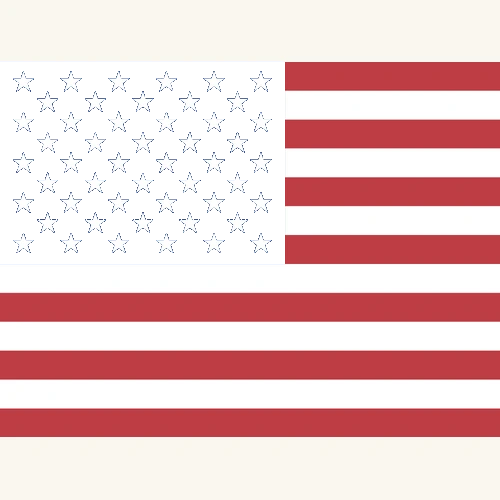
Fifty white stars make the canton feel unmistakable, but they also let memory file its colour under the vague label “navy.” U.S. law does not define #192F5D. Toon Tone scores it because that is the literal canton fill in the pinned [email protected] source artwork. The legal flag, a procured cloth flag and this sRGB rendering answer three different colour questions.
A constellation without a diagram
The Continental Congress resolution of 14 June 1777 required thirteen alternating red and white stripes and thirteen white stars in a blue field, “representing a new constellation.” It gave no blue shade, flag ratio, star-point count, orientation or arrangement. Circles, rows and other constellations could all satisfy the words; the familiar grid came much later.
White signifies purity and innocence, Red, hardiness & valour, and Blue, the colour of the Chief signifies vigilance, perseverance & justice.
Charles Thomson, Great Seal explanation submitted to Congress, 20 June 1782
The symbolism arrived five years later
That famous meaning arrived five years after the flag resolution, and in a different document. Thomson was explaining the shield of the Great Seal; he noted that its colours came from the flag, then assigned them meanings. The passage is the strongest official ancestor of modern flag symbolism, but it is not proof that Congress chose the blue field for vigilance in 1777.
From star variety to a federal grid
President Taft's 1912 order first standardized a star arrangement for the 48-state flag. After Alaska and Hawaii, Executive Order 10834 of 21 August 1959 fixed the 50-star positions and proportions; the design became official on 4 July 1960. Even that detailed geometry says only “a field of blue.” It never calibrates a digital colour.
A cloth standard is not a screen code
Federal cloth procurement uses another authority: current specification DDD-F-416H points to a physical Standard Color Reference of America swatch called Old Glory Blue, not an RGB or hex recipe. This card's screen target is #192F5D: RGB 25/47/93, HSB 221°/73%/36%. Pure blue is 240°, so 221° lies 19° toward cyan, not violet; green at 47 exceeds red at 25. The low 36% brightness is the trap — without the white stars, memory often lifts it toward a more familiar navy.
United States canton against the navy blues memory substitutes
#192F5DUnited States canton#012169United Kingdom blue field#002F6CFinland cross#21468BNetherlands bottom bandQuick facts
- Target
#192F5D· RGB 25/47/93 · HSB 221°/73%/36% - 1777 resolutionthirteen stripes · thirteen white stars · a blue field · no exact shade or star grid
- Symbolism sourceCharles Thomson's 1782 Great Seal explanation, not the 1777 Flag Resolution
- Digital boundary
#192F5Dis the pinned[email protected]fill; federal cloth specs use Old Glory Blue - Reads asvigilance · institutional weight · night-sky depth