Color anatomy
The exact scoring color for this Flag Tone card.
- HEX
#DA251D
- RGB
- 218, 37, 29
- HSB
- 3°, 87%, 85%
- HSL
- 3°, 77%, 48%
Nearby tones to compare against
#D93F1C#D91C2C#D93E36#D90D02#B51F18Why this color matters
Vietnam's yellow star is easy to remember; the red surrounding it is easier to replace with a generic “flag red”. Sharing red and yellow with China does not make the two cards the same colour. Vietnam's target is #DA251D: a substantial red with a slight warm lean. The yellow star makes a strong visual landmark, but it cannot tell memory the exact shade of the field.
Before the state, an uprising
The red flag with a yellow star appeared in the Nam Kỳ uprising against French colonial rule in southern Vietnam in November 1940. It became the flag of the Democratic Republic of Vietnam in 1945 and of the reunified Socialist Republic of Vietnam in 1976. The red is commonly understood as the blood shed in the struggle for independence and revolution. Those associations explain its historical weight; they do not prescribe a dark, dried-blood shade.
The background of the national flag is bright red, and the star is bright yellow.
Ministry of Culture, Sports and Tourism, Guidance 3420/HD-BVHTTDL, quoted by Nhân Dân (English translation)
The rule says fresh red, not a hex code
Article 13 of Vietnam's 2013 Constitution specifies a red rectangle with a central five-pointed gold star and a width equal to two-thirds of its length. The ministry's usage guidance is more descriptive about colour: đỏ tươi for the background and vàng tươi for the star, meaning fresh or bright red and yellow. Neither that constitutional clause nor the quoted colour instruction supplies an RGB triplet. #DA251D is this card's digital scoring reference, not a hexadecimal value written into those provisions.
A small but real warm lean
#DA251D is RGB 218/37/29, or HSB(3°, 87%, 85%) after rounding. Green exceeds blue by just 8, placing the hue slightly towards orange from pure red. Both saturation and HSB brightness are below maximum, yet this remains a strong red rather than a muted brown. The phrase “bright red” can tempt a player to push both controls to 100%; the symbolism of blood can pull a guess towards burgundy. Neither shortcut preserves these numbers.
One star, five points, one centre
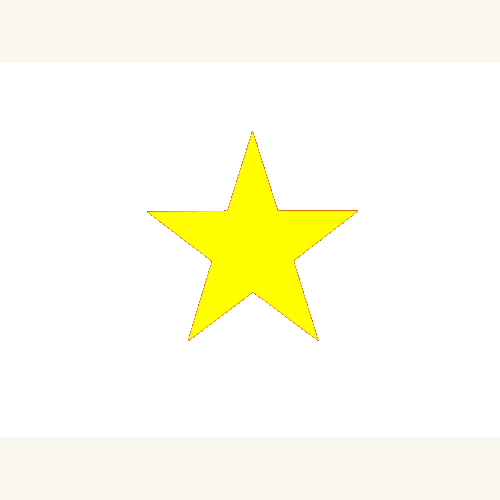
The ministry's guidance places the star exactly where the flag's diagonals meet, with the distance from its centre to each tip equal to one-fifth of the flag's length. It also requires the yellow stars on the two faces to coincide. The five points are commonly read as intellectuals, farmers, workers, traders and soldiers united. Vietnam's design concentrates that idea in one central star; China's card uses a cluster of five stars. Remembering that arrangement helps separate the two flags before comparing their reds.
Vietnam and the other flag reds memory borrows
#DA251DVietnam field - slightly warm red#EE1C25China field - cooler, higher HSB brightness#E30A17Turkey field - cooler, more saturated#C1272DMorocco field - cooler, lower HSB brightnessQuick facts
- Target
#DA251D· RGB 218/37/29 · HSB 3°/87%/85% - the red field - OriginsNam Kỳ uprising, November 1940 · national flag in 1945 · reunified Vietnam in 1976
- Colour wordingđỏ tươi: fresh or bright red; the cited provisions do not specify
#DA251D - One starCentred at the diagonals' intersection; centre-to-tip distance is one-fifth of the flag's length
- Reads asindependence · revolution · unity · strong red with a slight warm lean