The color, broken down
Four ways to describe one color. Each slider in the game maps to one of these dimensions.
- HEX
#DFA833
- RGB
- 223, 168, 51
- HSB
- 41°, 77%, 87%
- HSL
- 41°, 73%, 54%
Nearby tones that look right and are wrong
#DEBF33#DE9133#DEB04E#DE9F18#BA8D2BHow this color came to be
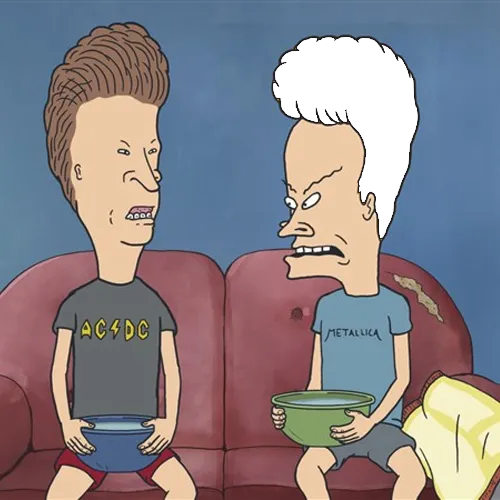
Beavis and Butt-Head premiered on MTV in 1993, created by Mike Judge — the same Mike Judge who later made King of the Hill, Office Space, and Idiocracy. Beavis is the blond half of the duo, fire-obsessed and prone to declaring himself "the Great Cornholio" whenever he eats too much sugar. His hair was built into the show's deliberately limited, intentionally crude visual language: minimal cel-paint colors, flat shading, a 90s MTV aesthetic that openly signaled "this is not Disney."
The hex breaks down to HSB(41°, 77%, 87%). Hue 41° is firmly in the warm yellow zone, about two-thirds of the way toward orange from pure yellow (60°). Saturation 77% is high but stops well short of maximum. Brightness 87% is similarly committed-but-not-maxed. The result is honey or amber territory — what designers call "warm blonde," distinct from the lemon yellow of Pikachu's fur or the screaming yellow of SpongeBob's body.
Players who reach for Beavis's hair almost always pick a yellow that's too bright, too pale, or too cool. The instinct on "blond hair" is to drift toward pale, low-saturation yellows. Beavis is none of those things: his hair is saturated and pushed warm. The matching strategy is to start at a pure orange, walk the hue cool by about 20°, pull saturation back from max by about a quarter, and let brightness settle near 87%.
How to match it from memory
Calibrated to this character's specific hex, not generic color advice.
- Hue: ~40° — pulled warm from pure yellow, toward orange.
- Saturation: ~77% — high but not maxed.
- Brightness: ~87% — high but not maxed.
- Common mistake: matching "blond" with a pale yellow; Beavis is amber, not pale.